


Seed Cycling + Collagen Peptides Duo
Seed Cycling + Collagen Peptides Duo
Couldn't load pickup availability
- Carefully Packed & Shipped. Choose your preferred carrier at checkout.
Ideal for
Ideal for
This product is for you if:
- You want seed cycling and collagen support in one daily habit
- You are focused on skin elasticity, hydration, or reducing signs of ageing
- You are experiencing hair thinning or changes in nail strength
- You want to support gut lining integrity alongside your seed cycling practice
- You are in perimenopause or menopause — a phase where both collagen decline and hormonal shifts accelerate simultaneously
- You want marine collagen specifically for its superior bioavailability over bovine sources
- You want a clean, organic, wholefood-based collagen without synthetic additives
Clinical research on collagen peptides shows measurable results typically after 8–12 weeks of consistent daily use. The subscription is structured to support this.
How to Seed Cycle
How to Seed Cycle
Add one scoop to a smoothie, yoghurt, warm drink, or coconut water.
Take Phase 1 daily from day 1 of your period through to ovulation. If you are unsure when you ovulate, switch on day 15. If you have no regular cycle, start on the New Moon.
Take Phase 2 daily post ovulation through to your next period. Or post Full Moon if following the lunar calendar.
QUALITY AND TESTING
QUALITY AND TESTING
Our wild caught marine collagen is independently tested to ensure it meets strict quality, purity, and safety standards before it goes into your blend. Here is the full testing data:
Protein content: greater than 97% of dry substance
Average molecular weight: 1000 Daltons or less — this small particle size is what gives marine collagen its superior bioavailability over bovine sources
pH (10% aqueous solution): 5.0 to 7.0
Stacking density: 0.28–0.45 g/ml
Heavy Metal Testing
Lead: 1.0 ppm or less
Arsenic: 1.0 ppm or less
Chromium: 2.0 ppm or less
Cadmium: 0.1 ppm or less
Mercury: 0.1 ppm or less
Microbiological Testing
Total aerobic microbial count: less than 1,000 CFU/g
Total yeast and mould count: less than 50 CFU/g
Salmonella (per 25g): Negative
Staphylococcus aureus: Negative
All results meet or exceed international food safety standards. This testing is conducted on every batch to ensure consistency and safety across every order.
Ingredients
Ingredients
Phase 1 — Seed Cycling + Collagen
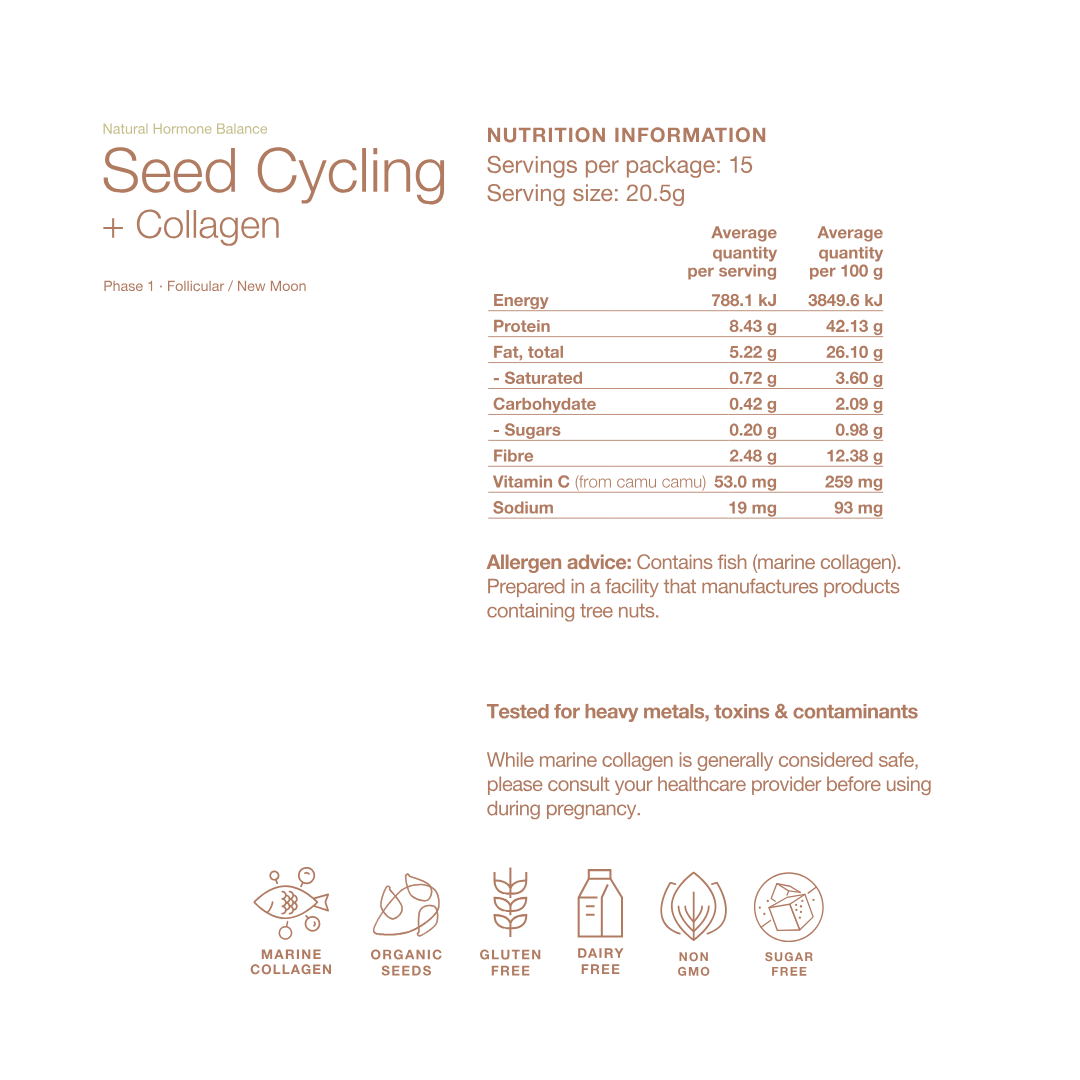
Organic Cold-Milled Flaxseeds, Organic Cold-Milled Pumpkin Seeds, Wild Caught Marine Collagen Peptides, Organic Camu Camu
Phase 2 — Seed Cycling + Collagen
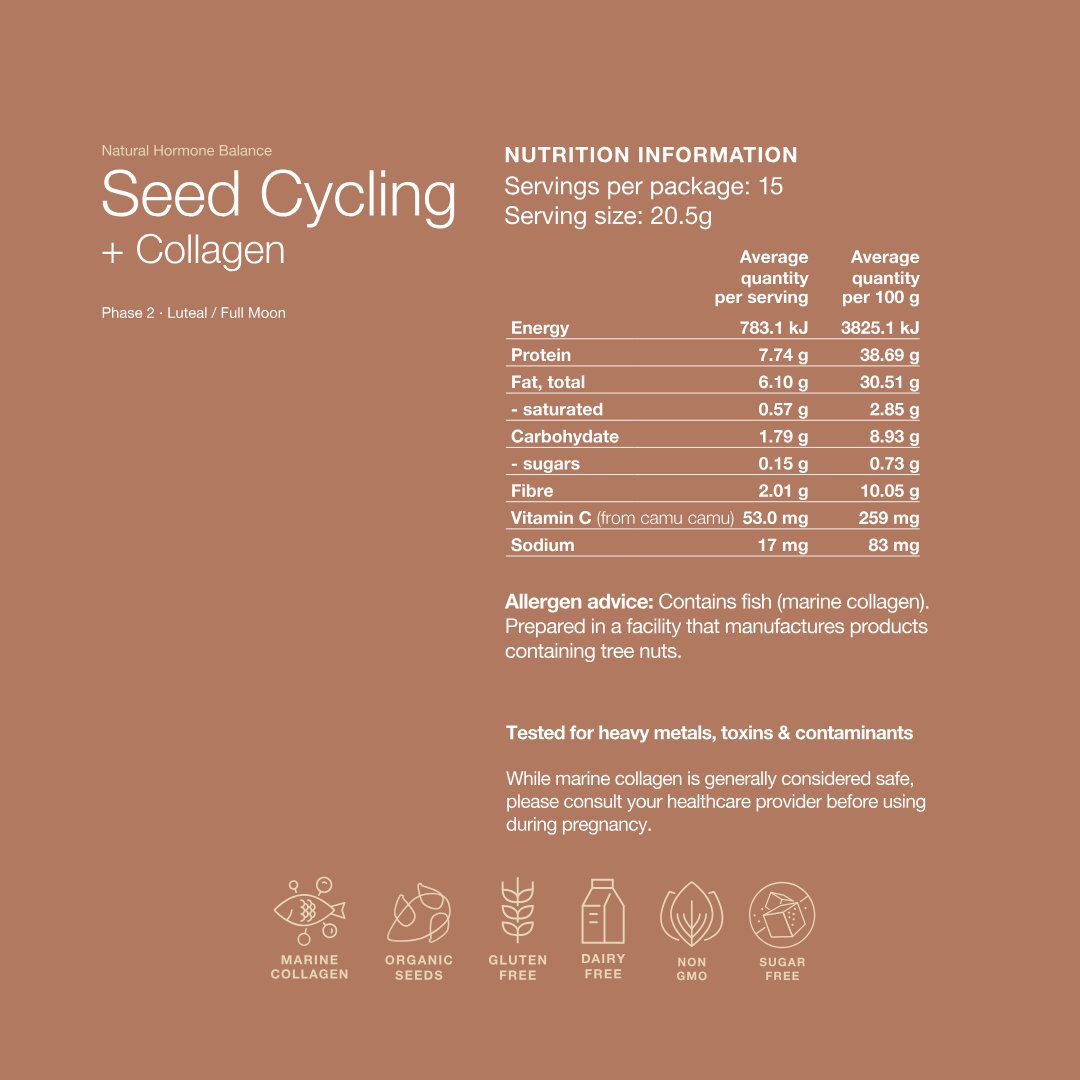
Organic Cold-Milled Sesame Seeds, Organic Cold-Milled Sunflower Seeds, Wild Caught Marine Collagen Peptides, Organic Camu Camu
Allergens: Contains fish (marine collagen). Contains sesame. Gluten free. Dairy free. Not suitable for vegans or those with fish allergies.
Shipping
Shipping
Free shipping within Australia on orders over $140. International shipping available — rates calculated at checkout.
Orders are dispatched promptly and you will receive a tracking number as soon as your order leaves our facility. See our full shipping policy for delivery timeframes.
For more info head to our shipping policy.



Seed cycling and collagen.
Inside and out.
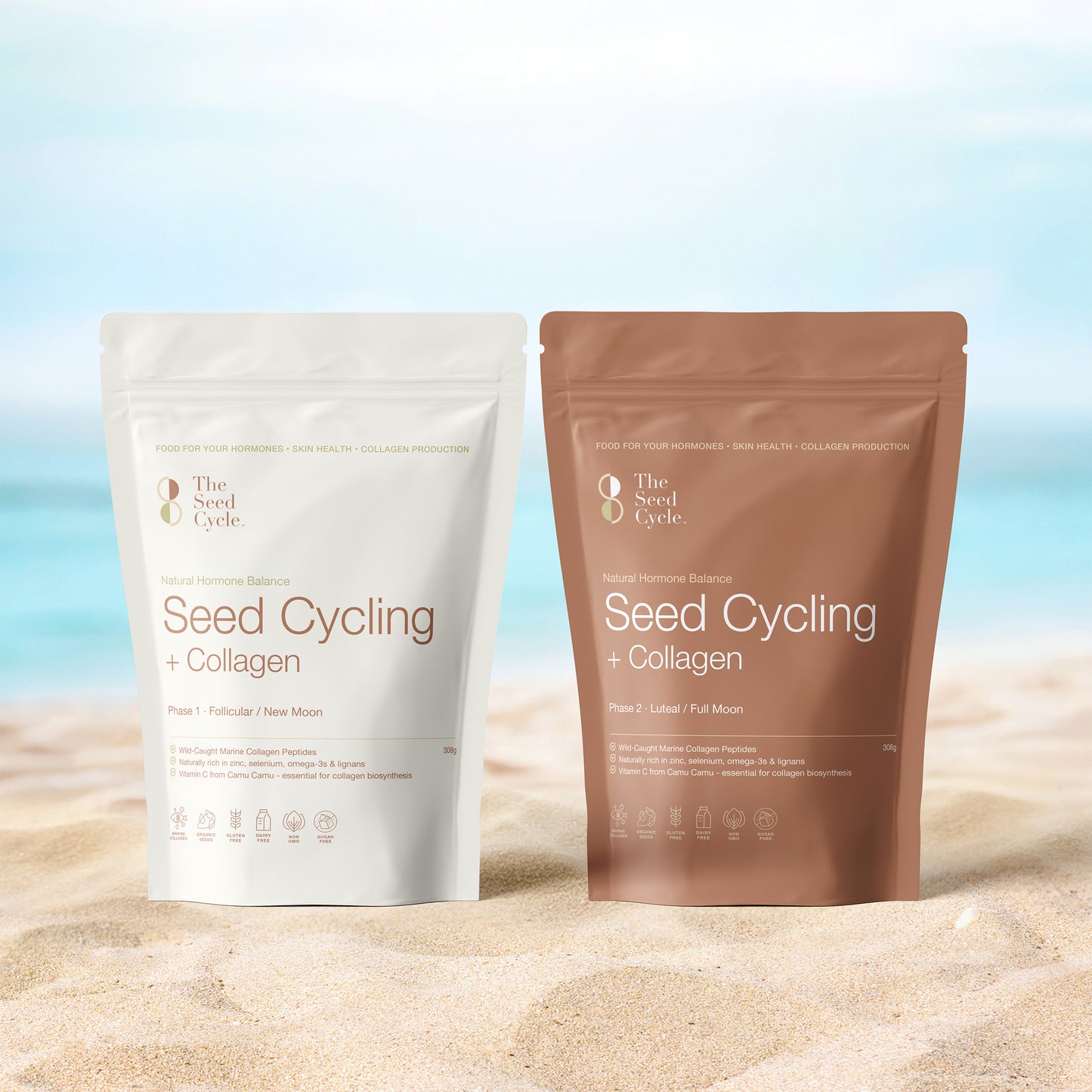
The Collagen Duo takes the original seed cycling protocol and adds wild caught marine collagen peptides and organic camu camu to both phases. Seeds for the cycle. Collagen for what shows on the outside. Camu camu to help the collagen actually work.
One scoop daily. Add to a smoothie, yoghurt, or warm drink. Same seed cycling ritual — with skin, hair, nails, and gut support added in.
What collagen actually
does in the body
Collagen is the most abundant protein in the human body — the structural foundation of skin, hair, nails, connective tissue, and the gut lining. Production naturally declines from around age 25 onwards.
The body's structural protein
Collagen makes up approximately 30% of total body protein. It forms the scaffolding that holds skin firm and elastic, keeps joints cushioned, and maintains the integrity of the gut lining. It is not one thing — there are over 28 types of collagen, with Types I, II, and III being most abundant in the human body.
Production declines with age
Collagen synthesis begins to slow from around age 25 — by around 1-2% per year. By the time most women are in their 30s and 40s, the effects are visible in skin elasticity, nail strength, and hair texture. Hormonal shifts — particularly around perimenopause and menopause — can accelerate this decline further.
How supplemental collagen works
When you consume collagen peptides, they are broken down into amino acids during digestion — particularly glycine, proline, and hydroxyproline. These amino acids are the building blocks the body uses to synthesise its own new collagen. Research suggests that collagen peptides, when taken consistently, can stimulate fibroblasts — the cells that produce collagen — to increase their output.
Not all collagen
is created equal
There are several sources of supplemental collagen — bovine (cow), porcine (pig), chicken, and marine (fish). We use wild caught marine collagen peptides specifically, and the distinction matters.
Marine collagen is predominantly Type I collagen — the most abundant type in human skin, hair, nails, and connective tissue. It has a smaller molecular weight than bovine collagen, which means it is more readily absorbed through the gut wall and into the bloodstream.
Wild caught specifically means the fish are sourced from open water rather than farmed environments — no antibiotics, no growth hormones, and a more sustainable sourcing practice than fish farming.
Type I Collagen — the skin collagen
Marine collagen is predominantly Type I — the specific collagen type that makes up approximately 80% of skin. More targeted for skin elasticity and firmness than bovine sources which are higher in Type II and III.
Superior bioavailability
Marine collagen peptides have a lower molecular weight than bovine collagen — approximately 300-500 Daltons vs 15,000-50,000 Daltons. This smaller particle size means faster and more complete absorption through the intestinal lining.
Wild caught — cleaner sourcing
Sourced from wild caught deep sea fish rather than farmed environments. No antibiotics, no artificial growth hormones, and a more sustainable practice that supports marine ecosystem health.
Hydrolysed for absorption
The collagen in our blends is hydrolysed — broken down into smaller peptide chains before you consume it. This pre-digestion step makes it significantly easier for the body to absorb compared to non-hydrolysed collagen.
Skin. Hair. Nails.
Gut.
Each of these areas relies on collagen as a structural component. Here is what the research says about supplemental collagen and each one.
Skin
Skin is approximately 75% collagen by dry weight. As production declines, skin loses its structure and elasticity — the scaffolding that keeps it firm begins to break down. A 2019 systematic review in the Journal of Drugs in Dermatology analysed 11 studies on oral collagen supplementation and found consistent improvements in skin elasticity, hydration, and dermal collagen density. Results were typically seen after 8–12 weeks of consistent daily use.
Hair
Hair follicles are surrounded by a collagen-rich dermal sheath. Collagen provides the amino acids — particularly proline — needed for keratin synthesis, which is the primary structural protein in hair. Research suggests that collagen peptide supplementation may support hair follicle health and reduce hair thinning, particularly relevant during hormonal transitions when hair loss is common. A 2021 study in the Journal of Cosmetic Dermatology found significant improvements in hair thickness and scalp coverage after 6 months of collagen peptide supplementation.
Nails
Nails are made primarily of keratin, which requires the amino acids found in collagen peptides for its production. A 2017 study published in the Journal of Cosmetic Dermatology found that daily collagen peptide supplementation over 24 weeks led to a 12% increase in nail growth rate and a 42% decrease in the frequency of broken nails. 64% of participants reported an overall improvement in brittle nail appearance.
Gut
Collagen — specifically glycine and proline — plays a key role in maintaining the integrity of the intestinal lining. The gut wall is rich in connective tissue, and collagen peptides provide the structural support it needs to function as an effective barrier. Research suggests that glycine, found in abundance in collagen, has anti-inflammatory properties that may support gut lining health and digestive comfort. Marine collagen is also easily digested, making it well-tolerated even for those with sensitive digestive systems.

Nourished from
the inside
Collagen supplements work from the inside out. Unlike topical creams which can only penetrate the outer layers of skin, oral collagen peptides are absorbed into the bloodstream and delivered to the dermal layer where new collagen is actually synthesised.
The key is consistency — clinical studies showing measurable skin improvements typically run for 8–12 weeks of daily use. This is why we built the Collagen Duo as a subscription product. The habit needs to become daily and automatic for the results to accumulate.
One scoop of the correct phase blend each day. That is it.
Seed cycling and collagen.
A natural pairing.
The seeds and the collagen address different but complementary aspects of women's health. Here is what each brings to the daily ritual.
Seed cycling protocol
- Phase 1 seeds (flaxseed + pumpkin) provide lignans, omega-3 ALA, zinc, and magnesium across the follicular phase
- Phase 2 seeds (sesame + sunflower) provide lignans, vitamin E, selenium, and calcium across the luteal phase
- Lignans support oestrogen metabolism and the gut microbiome
- Zinc and selenium support skin cell renewal and antioxidant defence
- Vitamin E is a fat-soluble antioxidant that supports skin health and reduces oxidative stress
Wild caught marine collagen
- Provides the amino acid building blocks — glycine, proline, hydroxyproline — for the body's own collagen synthesis
- Stimulates fibroblasts to increase collagen production in the dermal layer
- Supports the structural integrity of skin, hair follicles, nails, and gut lining
- Wild caught and hydrolysed for maximum bioavailability and absorption
- Camu camu provides vitamin C — essential for collagen synthesis and absorption

Why camu camu
makes it work
Vitamin C is not optional when it comes to collagen — it is essential. The body cannot synthesise collagen without it. Vitamin C is a required cofactor for two enzymes — prolyl hydroxylase and lysyl hydroxylase — that are critical to the collagen synthesis pathway. Without adequate vitamin C, the collagen triple helix cannot form properly.
We use organic camu camu as our vitamin C source rather than synthetic ascorbic acid. Camu camu is a small Amazonian fruit and one of the most concentrated natural sources of vitamin C on the planet — containing up to 60 times more vitamin C per gram than an orange.
Up to 60x more vitamin C than orange
Gram for gram, camu camu is one of the most concentrated natural sources of vitamin C available.
Collagen cofactor
Vitamin C is required for the enzymes that build the collagen triple helix. No vitamin C, no collagen synthesis.
Antioxidant protection
Vitamin C neutralises free radicals that break down existing collagen — protecting what you have while you build more.
Whole food source
Organic camu camu rather than synthetic ascorbic acid — a whole food vitamin C source with natural bioflavonoids.
Two phases.
Full month covered.
Both Phase 1 and Phase 2 collagen blends are included in the Duo — each with the correct seed cycling seeds plus marine collagen and camu camu.

Phase 1 + Collagen
Organic cold-milled flaxseed and pumpkin seeds with wild caught marine collagen peptides and organic camu camu. The follicular phase blend — seed cycling foundations with collagen and vitamin C support.

Phase 2 + Collagen
Organic cold-milled sesame and sunflower seeds with wild caught marine collagen peptides and organic camu camu. The luteal phase blend — vitamin E and selenium from sunflower seeds work alongside collagen for skin antioxidant support.
Honest about
the evidence
Marine collagen is one of the more well-researched supplements for skin, hair, nails, and gut health. Here is a summary of the key findings — and where the evidence is strongest.
Elasticity and hydration
A 2019 systematic review in the Journal of Drugs in Dermatology reviewed 11 randomised controlled trials and found consistent improvements in skin elasticity, hydration, and dermal collagen density after 8–12 weeks of daily oral collagen peptide supplementation. The evidence base for skin is the most robust of all four areas.
Growth and brittleness
A 2017 study in the Journal of Cosmetic Dermatology found a 12% increase in nail growth rate and 42% reduction in broken nail frequency after 24 weeks of daily collagen peptide supplementation. 64% of participants reported visible improvement in brittle nail appearance.
Thickness and coverage
A 2021 study in the Journal of Cosmetic Dermatology found significant improvements in hair thickness and scalp coverage after 6 months of daily collagen peptide supplementation. Research in this area is growing but less extensive than for skin and nails.
Intestinal integrity
Glycine and proline — the primary amino acids in collagen — are critical to gut lining integrity. Research suggests glycine has anti-inflammatory properties relevant to gut health. The clinical evidence for collagen and gut specifically is still developing, though the mechanistic basis is well-established.
Collagen synthesis requires it
The role of vitamin C as a required cofactor for collagen synthesis is well-established biochemistry. Without adequate vitamin C, the enzymes that form the collagen triple helix cannot function. Camu camu is one of the most concentrated natural vitamin C sources available.
Bioavailability advantage
Research comparing marine and bovine collagen suggests marine collagen has superior bioavailability due to its smaller molecular weight — approximately 300-500 Daltons versus 15,000-50,000 Daltons for bovine sources. This means faster and more complete absorption into the bloodstream.
One scoop.
Every morning.
Check your phase
Day 1 to ovulation — Phase 1 blend. Post ovulation to period — Phase 2 blend. No regular cycle? Phase 1 from new moon, Phase 2 post full moon.
One scoop daily
Add one scoop to a smoothie, yoghurt, warm drink, or coconut water. The collagen peptides dissolve easily in both hot and cold liquids — no blending required.
Be consistent
Collagen results build over 8–12 weeks of daily use. Same time each morning is easiest. Keep the jar on the bench next to whatever you make first thing.
Collagen works
with consistency
Clinical research on collagen shows results after 8–12 weeks of daily use. The subscription delivers every 26 days so you never run out — and never have a gap in your daily habit.


Our products are wholefoods and are not intended to diagnose, treat, cure, or prevent any disease or medical condition. Statements have not been evaluated by the Therapeutic Goods Administration (TGA). Customer experiences are individual and are not intended as health claims. Research cited is for informational purposes only. Always consult your healthcare professional for personalised dietary advice.
Her Health, Her Power - Our Community
-

Liz from the Fertility Summit
-

Ana from Nourish Us
-

Mel - Mel's World of Colour
-

Kristina FMG PRO
